Monday, 6 May 2013

THE IMPACT OF KENTE BEYOND THE SHORES OF AFRICA


Picture: Bill Clinton and wife in Kente
 Its renown has spread internationally, so that it is now one of the most admired of all fabrics in many parts of the world. Its colorfulness makes it stands out wherever. The strip-woven cloth called Kente, made by the Asante peoples of Ghana and the Ewe peoples of Ghana and Togo, is the best known of all African textiles.

 The cloth has its origin in the former Gold Coast of West Africa as a festive dress for special occasions – traditionally worn by men  and by women as an upper and lower wrapper its existence as spectacular apparel, however, has obscured its many other roles in Asante and Ewe culture, especially in royal regalia. Over the past forty years the cloth has been transformed into hats, ties, bags, shoes, and many other accessories, including jewelry, worn and used on both sides of the Atlantic. Individual Kente strips have found a permanent home in the United States and are especially worn as a ‘stole’ or applied to academic and liturgical robes.
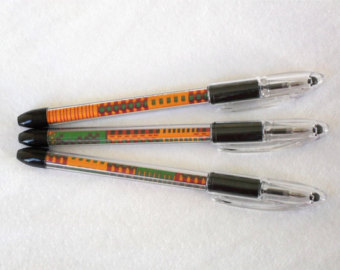
Kente patterns have also developed a life of their own and have been appropriated as surface designs for everything from Band-Aids and balloons to greeting cards and book covers. Appearing in contexts both sacred and profane, Kente has come to evoke and to celebrate a shared cultural heritage, bridging two continents.( America and Africa) – Doran Ross.
Kente has recently made more significant gains in the world of haute couture, Kente remains the textile of choice for African Americans and whites on many occasions that foreground issues of heritage and achievement. Kente with its vivid colors enmeshed in a visually compelling geometry has occupied a prominent role in the worlds of design, fashion, and politics during the second half of the twentieth century. Moreover, it has been a potent symbol in the context of many of the most important African American ideologies of the period.

The rather frequent wearing of Kente at special ceremonies by the first president of Ghana, Osagyefo Dr. Kwame Nkrumah placed Kente right in the eyes of the World, also Kente’s adornment of the walls of the United Nations general assembly auditorium has added to its strong stature in international circles. Kente, with all its glory, is not exempt from controversy in several interrelated arenas. At the forefront are debates concerning the primacy of Asante versus Ewe weaving. These involve issues of ethnic and cultural pride and reflect as well as still-lucrative indigenous markets. While certain clues as to its origin reside in the cloth itself, the fact is that the most of the arguments exist in the easily manipulated realm of oral tradition, rendering it impossible to determine definitely who influenced whom. Despite Kente’s obscure past, the fact remains that, the similarities between Asante and Ewe Kente, especially in central and northern Ewe areas, are much greater than any discernible differences.

The Homes of Kente In Asante, Bonwire continues to be regarded as home and center of Kente weaving, even though place like Adanwomase is prominent when it comes to Kente weaving and infact recognized as a seat for royal weavers. In Eweland, the most noticeable centers are Agbozume and Kpetoe. The institution of two festivals to celebrate and to market it to the World has enhanced the glory and the quest to celebrate Kente. In 1996, the Ewe town of Kpetoe created the first Kente festival (AGBEMEVOZA) to be followed by the creation of another one in 1998 in Asante weaving center Bonwire. (BONWIRE KENTE FESTIVAL) Isn’t it interesting and ironic that the most popular song composition to glorify Kente weaving composed by Ghana’s greatest musicologist, Dr. Ephraim Amu ( a very proud Ewe) was about the stunning weaving skills of Bonwire weavers, and what is most amazing is that one of the most prolific and legendarily skillful Kente weavers of Bonwire, a man called Samuel Cofie is an Ewe man born in Anyako, another Kente weaving town in Eweland. Cofie has been weaving Kente since 1961.

Kente, like any prominent has suffered the creation of fake ones on the market. Anyway, my parents did well to train me to discern the differences between Ewe and Asante Kente and of course l have the capacity to also discern fake, replicas or imitations of Kente when l encounter one.. Kente has been researched by many including Rattray in 1927. The Asantehene is told to have over 300,000 Kente cloths with a whole King “ Abenasehene” in charge of storing and maintenance.

Friday, 3 May 2013

KENTE ACCESSORIES

KENTE ACCESSORIES
Most Kente accessories include shoes, slippers, sandals, bags, ties, scarfs, pillow and many others including jewellery. Below are pictures of such accessories:


Picture credit: Agnes Arthur


 PICTURE CREDIT: GOOGLE SEARCH

KENTE FOR OCCASIONS

Kente has been in our society from time immemorial. The intrinsic pattern, colors and textures of the cloth with an inerrant boldness and pride makes the piece a unique feature.


Many a time, Kente is usually worn on special occasions like wedding ceremonies, corporate events and end of year parties of class. Of late, most fashion designers use the kente piece for accessories like ear-rings, ribbons, scarfs, head gears, shoes and many others and also for bridal decorations.


Kente cloth is usually worn for ceremonies, festivals, and other sacred occasions. It is also given as a gift for weddings, child naming ceremonies, graduations, and other special events.
The icon of African cultural heritage around the world, Asante kente is identified by its dazzling, multicolored patterns of bright colors, geometric shapes and bold designs.The Asante peoples of Ghana choose kente cloths as much for their names as their
colors and patterns.

The kente cloth is primarily used as an apparel for the would-be couple  yet to be joined as one at marriage ceremonies.

Most fashion designers have come up with different accessories that is used for decorations of events as well. Indeed Kente is a beautiful piece of cloth that has its own unique style.

BRIDE AND GROOM IN KENTE (picture credit: OAB PHOTOGRAPHY)


Tuesday, 2 April 2013

TYPES OF KENTE : EWE AND AKAN TRIBES

"KENTE" is a brilliantly colorful fabric (cotton, rayon, sheen, etc.) entirely or solely hand-woven on a horizontal treadle loom by the Asantes in Ghana, Africa. The Asante Kente is woven in the outskirts of Kumasi, in the area of Bonwire, Sakora Wonoo, Ahodwo and Ntonso. It is also woven by the Ewes in the Volta, Ghana.
 

The Ewe and Asante Kente have similarities but different significance with respect to the weaving process. These colors and designs associated with Kente have solely made the fabric the best known of all Ghanaian and even all African textiles.
Each design or cloth has a story with a proverbial meaning with its own distinction.


                                                                    AKAN : ASHANTI KENTE CLOTH


Kente cloth has its origin with the Ashanti Kingdom, and was adopted by people in Ghana and many other West African counties. It is an Ashanti royal and sacred cloth worn only in times of extreme importance and was the cloth of kings. Over time, the use of kente became more widespread. However, its importance has remained and it is held in high esteem with Akans.

Kente is predominantly made by the Ashanti people,(Bonwire,Adanwomase,Wonoo in the Kwabre areas of the Ashanti Region) and Akans (including the Brong, Ahafo, and Fante). Kente is also produced by Akan groups in Ivory Coast, such as the Baoule and Anyi. Lastly, Kente is worn by many other groups who have been influenced by Akans. It is the best known of all African textiles. Kente comes from the word kenten, which means basket in Asante. Ashantis refer to kente as nwentoma, meaning woven cloth.

The icon of African cultural heritage around the world, Asante kente is identified by its dazzling, multicolored patterns of bright colors, geometric shapes, and bold designs. Kente characterized by weft designs woven into every available block of plain weave is called adweneasa. The Asante people choose kente cloths as much for their names as their colors and patterns. Although the cloths are identified primarily by the patterns found in the lengthwise (warp) threads, there is often little correlation between appearance and name. Names are derived from several sources, including proverbs, historical events, important chiefs, queen mothers, and plants.

                                                                       EWE KENTE CLOTH

Although the Ewe (pronounced "Ev-ay") are not as well known outside Ghana as the Asante they also weave many of the cloths known worldwide as kente. In fact many collectors regards Ewe textiles as the highest expression of African weaving artistry. Ewe people live around the Volta delta area of south eastern Ghana and across the international border in Togo.

According to their local histories some groups reached their homeland in the seventeenth century after a series of migrations from the east, passing through the town of Notse in Togo. Others, around the more northern weaving town of Kpetoe claim an Akan origin from an area towards the coast near Accra. Unlike the Asante they were never a unified political entity with a powerful court, being ruled instead by numerous village chiefs and shrine priests. Perhaps as a consequence of this lack of a centralised royal authority imposing common standards Ewe weaving is far more diverse than that of the Asante. Although they do supply important regalia to local chiefs, Ewe weavers work primarily for sale through markets and to fill orders from important local men and women.

Today Ewe weavers are concentrated around two towns, Kpetoe and Agbozume, with the latter the site of a large cloth market which draws buyers from throughout Ghana as well as neighbouring countries.Ewe weavers utilise an almost identical form of the narrow-strip loom to that of the Asante, and there is considerable evidence to suggest mutual influence between the weavers of the two traditions, as might be expected from the long history of contacts, both through trade and conquest between their peoples. However Ewe weaving has also been influenced by and exercised an influence on other neighbouring peoples, including the Fon of the Benin Republic and most recently the Yoruba of Nigeria. One particularly interesting and distinctive type of Ewe cloth, sometimes called adanudo, features a rich variety of weft float inlaid pictures, often on a plain silk, rayon, or cotton background.

Among the subjects depicted on these cloths are animals such as cows, sheep and horses, human figures, ceremonial stools, hats, trees and flowers, and household objects such as dining forks. More recent examples are often quite realistic, and at least since the 1940s some of the cloths have included written texts. The Ewe weavers also produced many cloths where, as with Asante kente, the main design feature is symmetrically arranged blocks of weft float designs and weft faced stripes across the strips. However despite their superficial similarity, these cloths can generally be distinguished from Asante weaving by the inclusion of figurative designs of the type described above, and by the use of a technique which involves plying together two colours of weft thread before weaving a band, creating a kind of speckled effect. Ewe weavers also produced more simple but still striking cloths using just indigo blue and white stripes and checks, perhaps the legacy of older weaving styles practised before they came into contact with the Asante.